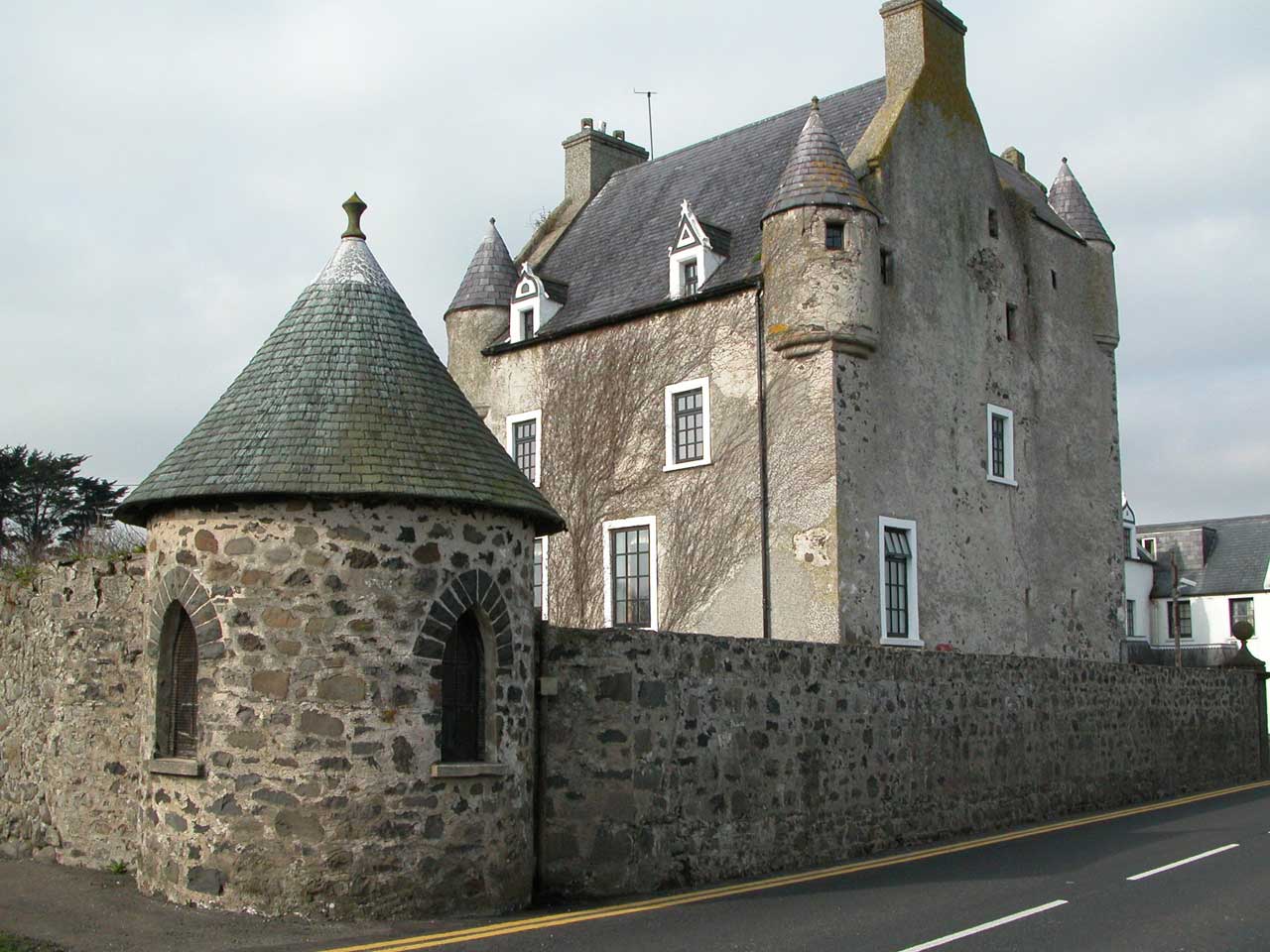
Ballygally Castle sits right beside the sea in the village of Ballygally, County Antrim, on Northern Ireland’s Causeway Coastal Route between Larne and Glenarm. It’s a tall, gray, steep-roofed building with little conical turrets, and it looks as if it was lifted straight out of the Scottish Lowlands. That’s not far from the truth.
Today it’s a hotel, which makes it one of the few haunted castles where you can have dinner, stay the night and climb the stairs to a room said to belong to its resident ghost.
The History of Ballygally Castle
A Scottish settler’s stronghold
The castle was completed in 1625 by James Shaw, who came from Greenock in Scotland. Shaw arrived in Ireland in 1606, during the early years of the Plantation of Ulster, when English and Scottish settlers were given land taken from Gaelic Irish families. In 1613 he received a sub-grant of land from Randal MacDonnell, Earl of Antrim, at a reported rent of £24 a year, and later built the castle there.
It was built with defense in mind. The walls are about five feet thick and are pierced with narrow loopholes for firing muskets. The design is distinctly Scottish: a steep roof, corner turrets, dormer windows and tall chimneys.
The doorway and its inscription
The original doorway still carries the date 1625 and an inscription in old Scots: “Godis Providens is my Inheritans” (God’s providence is my inheritance). Above it are the initials JS and IB, for James Shaw and his wife, Isabella Brisbane, along with a coat of arms. Alterations around 1760 mean the inscription is now inside the building.
Sieges and changing fortunes
The castle was soon tested. During the 1641 rebellion, Irish forces based at nearby Glenarm tried several times to take it, and it served as a refuge for local Protestant settlers during the wars of that century. It stayed in the Shaw family for generations, passing finally to William Shaw, often described as the last squire of Ballygally.
In the early 1800s the Shaws ran into money trouble and the estate was sold to the Agnew family. Over the following decades the castle was used as a coastguard station and then as a family home, first for the Reverend Classon Porter and later the Moore family. The coast road that now runs past its walls was only built in the 1840s. Before that, visitors arrived along a tree-lined avenue.
From castle to hotel
In the 1950s the castle was bought by Cyril Lord, the textile businessman known as the “Carpet King”, who turned it into a hotel. Hastings Hotels bought it in 1966 and still runs it. Extensions have added modern bedrooms and function rooms, but the 17th-century tower house remains at the heart of the building, and the bawn (defensive courtyard wall) and walled garden are protected as scheduled monuments.
You’ll sometimes read that Ballygally is the oldest occupied building in Ireland. That claim is disputed (Castle Upton, also in County Antrim, is generally considered older), but it is certainly one of the oldest buildings in Northern Ireland still in everyday use.
The Ghosts of Ballygally
Ballygally is often called one of the most haunted buildings in Northern Ireland, and the hotel embraces its reputation. As with any ghost story, the tales below are legends and reported experiences, not established fact, and the details vary depending on who’s telling them.
Lady Isabella Shaw
The best-known story concerns Lady Isabella, the wife of the castle’s builder. The legend says her husband married her mainly to secure an heir. When she gave birth, he took the baby away and locked her in a small room at the top of one of the turrets. Trying to escape, or to reach her child, she fell from the window to her death.
The versions disagree on key details. The hotel’s own heritage leaflet says the baby was a son, while many other tellings say she was punished for having a daughter. Some say she was starved, others that she jumped. There’s no historical record confirming any of it, but the story has been told for a very long time.
Her ghost is said to wander the corridors at night, knocking on doors, perhaps still searching for her child.
Madame Nixon
A second ghost is linked to Madame Nixon, a 19th-century resident who, according to the hotel, was a widowed relative of the Shaw family who came to live at the castle. Guests have reported knocking on bedroom doors late at night and the rustle of a silk dress moving along empty corridors.
Other reported experiences
Over the years guests and staff have described a sense of presence in their rooms, unexplained knocks and noises at night. There are also stories of a strange green mist hanging around the castle. Psychics and paranormal groups visit regularly, and journalists who have climbed to the Ghost Room often describe it as eerie and noticeably cold. Make of that what you will.
The Ghost Room
The Ghost Room sits at the top of a narrow spiral staircase in one of the turrets of the old castle, with a small window looking out over Ballygally Bay. It was once let to overnight guests, but these days nobody is allowed to sleep there. It’s open for visiting only.
If you plan to climb up:
- The stairs are steep and tight, so they’re not suitable for everyone.
- Ask at reception about access. Arrangements can change, especially when there are private events.
- Take a camera, but be respectful of other guests in the corridors of the older part of the building.
Visiting Ballygally Castle
Getting there
Ballygally is on the A2 coast road, a short drive north of Larne and about 40 minutes to an hour by car from Belfast, depending on traffic. Larne has ferry links to Scotland, so the castle makes an easy first or last stop on a Northern Ireland road trip.
Staying or stopping by
Because it’s a working hotel, you can:
- Stay overnight: a few bedrooms are in the original castle, with most in the newer wings. Ask when you book if you’d like to be in the old part.
- Eat or have afternoon tea: a good option if you just want to see the castle and the sea views without staying.
- Look at the details: the 1625 doorway, the thick walls and the old walled garden are all worth a few minutes.
Check the hotel’s website for current rooms, dining times and any seasonal events.
Make a day of the coast
Ballygally is the start of one of the most scenic drives in the UK. Heading north, the Causeway Coastal Route passes the Glens of Antrim, Glenarm, Carnlough, and eventually the Carrick-a-Rede rope bridge, Dunluce Castle and the Giant’s Causeway.
Final Thoughts
Ballygally Castle is a rare thing: a 400-year-old Plantation stronghold that still has people living, eating and sleeping inside it every day. The legend of Lady Isabella gives it an extra shiver, but even without the ghosts it’s a beautiful spot on a spectacular coastline, and well worth a stop.