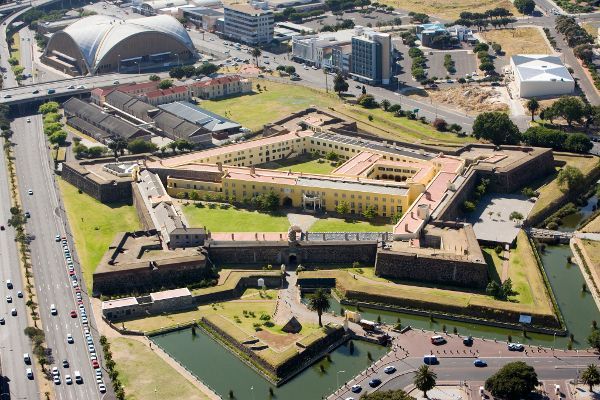
The Castle of Good Hope (in Dutch, Kasteel de Goede Hoop) sits in the middle of Cape Town, a short walk from the Grand Parade and City Hall. Built by the Dutch East India Company between 1666 and 1679, it is the oldest surviving colonial building in South Africa.
It also has a reputation as one of the most haunted places in the city. This guide covers the real history first, then the ghost stories that have grown up around the walls, and finally the practical details you need for a visit.
A Short History of the Castle
From mud fort to stone castle
In 1652 the Dutch East India Company (the VOC) set up a supply station on the shores of Table Bay. Its job was to provide fresh food and water to company ships sailing between Europe and Asia. Jan van Riebeeck, the first commander, built a small fort of clay and timber. It never really worked: Cape winter rains kept washing the earth walls away, and it needed constant repairs.
In the mid-1660s rumors of war between England and the Netherlands made the company nervous about a possible attack on the Cape. Commander Zacharias Wagenaer was told to build a proper stone fortress, and the cornerstone of the first bastion was laid on 2 January 1666. Work stalled when peace returned in Europe and sped up again when war broke out in 1672. The castle was finished in 1679.
Who built it
The castle’s own historians are frank that its construction had a human cost. Enslaved people, Khoikhoi workers, soldiers, settlers and sailors taken off passing ships quarried stone on Signal Hill, collected shells and burned them for lime, and hauled the materials into place. Small yellow clinker bricks, carried out from the Netherlands as ships’ ballast, were used for decorative details.
Five bastions with royal names
The castle follows the classic pentagon design used for European forts of the period, with a pointed bastion at each corner so defenders could cover every wall with cannon fire. In 1679 the five bastions were named after the titles of William III of Orange-Nassau:
- Leerdam (to the west)
- Buuren
- Katzenellenbogen
- Nassau
- Oranje
When it was built, the castle stood close to the shoreline of Table Bay. Later land reclamation pushed the coast far out, which is why it now sits well inland among roads and office blocks.
Life inside the walls
The castle was more than a military base. It was a small town: barracks, workshops, a church, stores, quarters for enslaved workers and the governor’s residence all sat inside the walls. Simon van der Stel moved into the commander’s quarters in 1680.
For roughly 150 years it was the center of civil, administrative and military life at the Cape. It was also a place of punishment. Its most notorious cell was the Donker Gat (“dark hole”), a dungeon where prisoners were held in near-total darkness. The best-known prisoner was the burgher Adam Tas, locked up in 1706 for organizing protests against Governor Willem Adriaan van der Stel. Stories that the dungeon was built to flood at high tide and drown prisoners are often repeated, but they belong to the castle’s folklore rather than its documented history.
The British took over the Cape in the 1790s and again in 1806, and the castle remained a military headquarters well into modern times. Today it is a museum and heritage site that still has a military connection.
The Ghost Stories
A building this old, with a history of prisons and executions, was always going to collect ghost stories. None of them can be proven, and some have clearly grown in the retelling. But they’re part of how Capetonians talk about the castle, and soldiers on night duty have told local newspapers about strange noises over the years.
Governor van Noodt and the curse
The most famous legend involves Pieter Gysbert van Noodt, governor of the Cape from 1727 to 1729 and remembered as a harsh ruler. In April 1729 a group of soldiers who had tried to desert were tried, and four were sentenced to hang. The records agree that the executions took place on the morning of 23 April 1729 and that van Noodt died suddenly that same afternoon.
The legend adds the dramatic part. As the story goes, one of the condemned men called on God to judge the governor before he died. When officers went to report that the sentences had been carried out, they found van Noodt dead in his chair with a look of terror on his face. The curse comes from later accounts, not the official records. His ghost is said to roam the castle, still unable to escape it.
Lady Anne Barnard
Lady Anne Barnard was a Scottish writer and artist who lived at the castle from 1797 while her husband, Andrew Barnard, served as colonial secretary. She was a famous hostess, and the legend is that she still enjoys a good party: guests at evening functions in the castle’s reception rooms have claimed to see a woman in an old-fashioned gown among them.
The figure on the walls
Night guards have long reported footsteps pacing the battlements between the Leerdam and Buuren bastions when nobody is there. Some versions describe a tall, glowing figure that stops to lean over the wall and look down at the street. Others link the sounds to a soldier said to have hanged himself in the bell tower centuries ago.
The Lady in Grey and the black dog
Two more figures turn up in most lists of the castle’s ghosts. One is a sad woman in a long gray cloak who is said to cover her face as if crying. Local tellings say she has been seen less since a woman’s skeleton was found during excavation work. The other is a large black dog that supposedly lunges at visitors and vanishes before it touches them.
Visiting the Castle of Good Hope
Opening hours and tickets
At the time of writing the castle is open daily from 9:00 to 16:00, with last tickets sold at 15:15. It closes only on Christmas Day and New Year’s Day. Adult tickets are modestly priced, with reduced rates for children and South African pensioners. Prices are listed “until further notice”, so check the official site before you go.
What to see
- Guided tours: run several times a day and are the best way to hear the history (and a few ghost stories) from people who know the building.
- The Key Ceremony: a re-enactment of the daily unlocking of the castle. It runs Monday to Friday and depends on the weather.
- Cannon firing: another regular ceremony. It doesn’t take place on Sundays and also depends on the weather.
- Museums: the Military Museum, the William Fehr Collection of paintings and decorative arts linked to the early Cape, and a permanent ceramics exhibition in the old granary.
- The Krotoa memorial: honors Krotoa, a Khoi woman who worked as an interpreter in the early colony. In a 2016 ceremony her spirit was symbolically returned to her original burial place at the castle.
- The battlements: walk the walls for views of Table Mountain and the city.
Practical tips
- The entrance is at the corner of Castle and Darling Streets in the city center, next to the Grand Parade.
- The site is wheelchair-friendly, but the courtyards and walls are uneven in places, so wear comfortable shoes.
- Cape Town weather changes quickly. Bring a layer even on a sunny day, especially for the walls.
- The castle doesn’t run its own ghost tour. Some private operators run tunnel and history tours that start nearby, and they must be booked in advance.
For current times, prices and events, see the official website: castleofgoodhope.co.za.
Is It Worth Visiting?
Yes, even if you don’t believe in ghosts. The castle tells the story of the Cape’s colonial past in one compact site. Go for the history, stay for the views from the walls, and if you hear footsteps on the battlements near Leerdam, you’ll know which legend to blame.