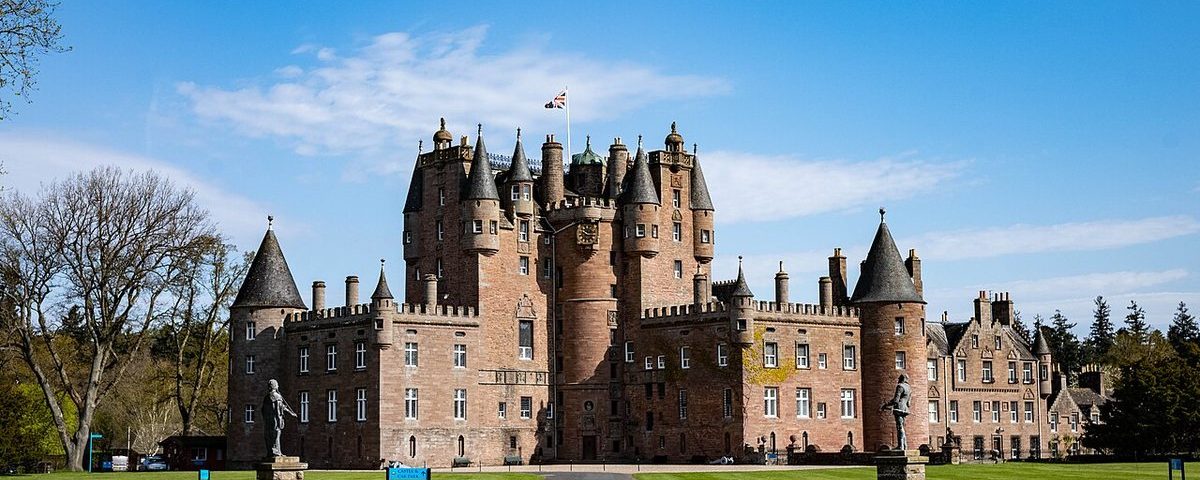
Glamis Castle (pronounced “glahmz”) stands in the broad valley of Strathmore in Angus, Scotland, and has been the home of the Lyon family, later the Bowes-Lyons, since the 14th century. It is the seat of the Earl of Strathmore and Kinghorne, it was the childhood home of Queen Elizabeth the Queen Mother, and it is open to visitors. It also has one of the oldest and most elaborate ghost reputations of any castle in Britain, built from several stories that do not quite agree with each other. This guide sets out the castle’s history, the legends, what the record can and cannot support, and how to visit.
A short history of Glamis Castle
The site is old. The castle’s own timeline says King Malcolm II was killed here in 1034, and Shakespeare later made Glamis the home of Macbeth in his play, although Wikipedia notes that the real King Macbeth had no known connection to the place. The estate was granted by Robert II to Sir John Lyon in 1372, and the same family has held it ever since. Sir John married the king’s daughter, Joanna, in 1376, and was killed in 1382 after a quarrel with James Lindsay.
The castle visitors see today grew out of an early 15th-century tower house. The castle says that building of the present structure began in 1400. In 1606 Patrick Lyon, 9th Lord Glamis, was created Earl of Kinghorne and began major works, and the present building is largely 17th century in character. Historic Environment Scotland lists it as a Category A building. In the 1760s the 9th Earl of Strathmore married Mary Eleanor Bowes, an heiress, and the family name became Bowes-Lyon. Lady Elizabeth Bowes-Lyon, the future Queen Mother, was born in 1900, and her daughter Princess Margaret was born at the castle in 1930. The castle served as a hospital during the First World War and survived a serious fire in September 1916.
The ghost legends of Glamis
The Grey Lady: Janet Douglas
The most historically grounded of the Glamis stories concerns Janet Douglas, Lady Glamis. She was the wife of John Lyon, 6th Lord Glamis, and the sister of Archibald Douglas, Earl of Angus, the stepfather and rival of King James V. After her husband died in 1528 she was accused of poisoning him, and later of treason and of plotting against the king. The castle’s timeline says the accusations were false and that her real offence was her family connection. She was burned at the stake on Castle Hill in Edinburgh on 17 July 1537, and Glamis was forfeited to the Crown.
The ghost story is that she still haunts the castle, usually described as the Grey Lady, though some tellings say White Lady, and that she is seen kneeling in the small chapel. Wikipedia says tour guides tell visitors that one seat in the chapel is kept free for her. A blog from The Bowes Museum, whose co-founder John Bowes descended from the family, says visitors have reported an atmosphere of sadness there. The execution is documented history. The apparition is a tradition, and no document supports it.
Earl Beardie and the card game
Another old tale is that of “Earl Beardie,” a 15th-century lord who one Sunday refused to stop playing cards. In the usual versions he swore he would play until doomsday, or with the Devil himself, and a stranger then arrived to take up the challenge. Wikipedia notes that the tale is attached to two different men, Alexander Lyon, 2nd Lord Glamis (died 1486), and Alexander Lindsay, 4th Earl of Crawford (died 1453). In some versions the earl is condemned to play cards until the end of time. The sources read for this post do not settle which man, if either, the story really concerns.
The Monster of Glamis
The best-known story is the Monster of Glamis: that a heir to the earldom was born so badly deformed that the family hid him in a secret chamber for his whole life. The historian Mike Dash, writing in Smithsonian Magazine, traces how the tale developed. When Sir Walter Scott spent a night at the castle in 1790, he wrote of a hidden room but said nothing about an occupant. The first reports of a prisoner appear in the 1840s. By the second half of the century Victorian guests were speculating freely, and a story about a “human toad” circulated. Dash notes that Douglas’s Scots Peerage records a son born and died on 21 October 1821, and that believers have tried to link him to the legend. Dash presents that link as speculation.
One famous anecdote has a countess and her guests hanging towels and sheets from every window to find the hidden room, which a Victorian diplomat dated to 1850. Dash writes that accounts disagree on whether one window or several remained unmarked, and that the earl was angry on his return. Dash also notes that the 13th Earl, Claude Bowes-Lyon, is said to have remarked that anyone who could guess the castle’s secret “would get down on your knees and thank God it was not yours.” The best-known sceptical voice is the 27th Earl of Crawford, who visited in 1905 and wrote in his diary that the secret was that there was no secret, and that his hosts “invent stories to suit the idiosyncracies of each guest.”
Dash’s impression is that the Monster story may have replaced an earlier Victorian tale. In that older version, a party of Ogilvies seeking shelter from their enemies was walled into the hidden room and left to starve, and their skeletons were the family secret. Dash dates the shift from the Ogilvy story to the Monster to the early 20th century. Relatives who spoke to the writer James Wentworth-Day in the 1960s gave mixed answers. The 16th Earl said he knew nothing of any secret, while an aunt of Queen Elizabeth II recalled that the children were forbidden to discuss it. The legend is therefore best treated as a layered piece of folklore with a long Victorian history, not as an event.
Visiting Glamis Castle
Glamis Castle is beside the village of Glamis in Angus, with the postcode DD8 1QJ. Visits are by guided tour, and the castle has seasonal opening times that change from year to year, so check the official Glamis Castle website before travelling. On October 25, 2026 it listed these dates:
- 26 October to 1 November: open daily from 10am, with last entry and tour at 3:30pm.
- 2 November to 20 December: open Thursday to Sunday from 10am, with last entry and tour at 3:30pm.
Tickets are sold through the castle’s booking page, which offers castle tours, gardens-only tickets and special events. The castle also ran a Halloween event called Ghouls and Gore from 23 to 31 October 2026, with evening ghost tours. Dates and prices vary, so book through the official site.
Practical tips
- Parking: The official FAQ says the car park behind the Pavilion Shop has ample space and is included in pre-booked tickets.
- Food: The Castle Kitchen Restaurant serves drinks, lunches and afternoon teas, and the Old Larder offers takeaway drinks and snacks.
- Dogs: Dogs on leads are welcome in the gardens and grounds. The FAQ does not say they may enter the castle.
- Children: Children under 12 must be accompanied by an adult at all times.
- Ground rules: The castle warns of uneven surfaces and works in the gardens. Drones, barbecues and fires are not allowed, and cycling is not permitted in the gardens.
FAQ
Is Glamis Castle haunted?
It has a famous reputation for it, but every ghost story is legend. The execution of Janet Douglas is documented history, while the Grey Lady, Earl Beardie and the Monster are folklore with no firm evidence behind them.
What is the Monster of Glamis?
It is the story of a deformed heir said to have been kept in a hidden room. Historians such as Mike Dash trace it to Victorian gossip and find no evidence that it was true.
Is Glamis Castle open to visitors?
Yes, on a seasonal schedule, by guided tour. Check the official site for current dates and tickets.
More haunted castles: Another Scottish castle with a ghost-story reputation is Culzean Castle in Ayrshire. Other tales of a lady in white can be found at Château de Puymartin in France, and Northern Irish and South African castles are covered in the posts on Ballygally Castle and the Castle of Good Hope.
Sources
- Glamis Castle: official website: current opening dates and closure notice, checked October 25, 2026.
- Glamis Castle: timeline: 1034, 1372, 1382, 1400 and the Janet Douglas entry.
- Glamis Castle: FAQs: parking, dogs, food and visitor rules.
- Wikipedia: Glamis Castle: history, Earl Beardie, chapel seat, listings.
- Mike Dash, Smithsonian Magazine: The Monster of Glamis: history of the Monster legend.
- Mike Dash: The Monster of Glamis (first draft): the Ogilvy version.
- The Bowes Museum: The gruesome story of Janet Douglas: Janet Douglas and the Grey Lady tradition.
Shop the gear
Heads up: NicheStuff is our own shop, so we earn from purchases made through these links. Prices and availability are set on the store and can change.
Top image: Glamis Castle in Angus, Scotland. Photo: rboed*, CC BY 2.0, via Wikimedia Commons.