
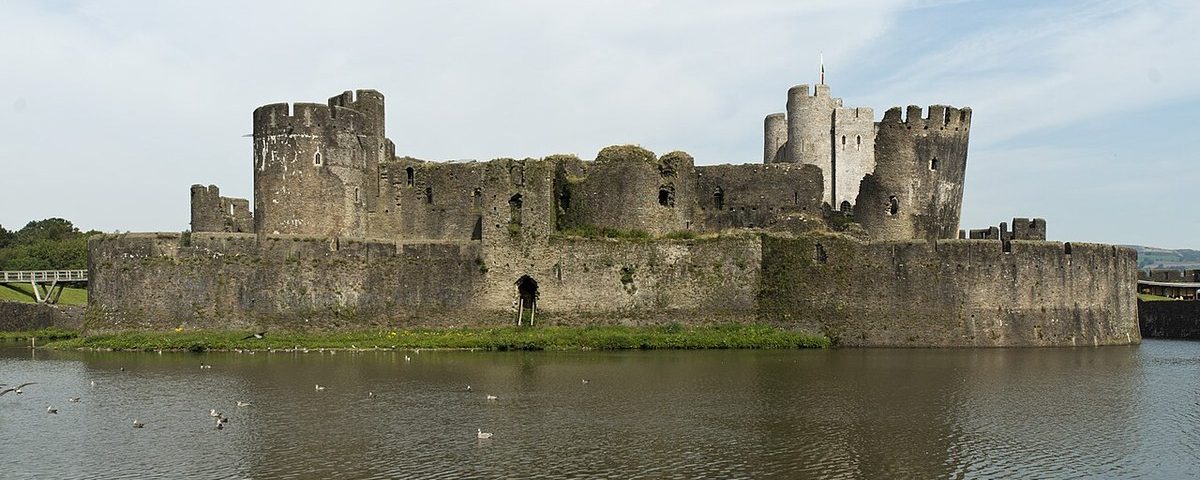
Caerphilly Castle rises from a broad network of artificial lakes in the middle of the town of Caerphilly, north of Cardiff in South Wales. It covers around 30 acres, and Wikipedia describes it as the largest castle in Wales and the second largest in the United Kingdom. It is also the home of one of Wales’s best-known castle ghost stories, the legend of the Green Lady. This guide covers the castle’s history, the tales told about it, what the record does and does not support, and how to visit.
A short history of Caerphilly Castle
The castle was the work of Gilbert de Clare, nicknamed “Red Gilbert” for his hair, who inherited the de Clare lands in 1263 and held the earldom of Gloucester and the lordship of Glamorgan. After a baronial revolt in England was crushed in 1266 and 1267, he pushed north from Cardiff into Glamorgan and began a new castle at Caerphilly in 1268. It sat in a basin of the Rhymney Valley, beside a former Roman fort, in the path of the Welsh prince Llywelyn ap Gruffudd, who was also expanding his power in the region.
Work moved quickly. Ditches were cut, a stream was dammed to create the lakes, and most of the walls and inner buildings went up within a few years. Llywelyn burned the site in 1270. In 1271 bishops sent by Henry III took control of it, and in 1272 de Clare’s men took it back and building resumed. Work on the defences largely stopped around 1290. The architect is unknown. The concentric rings of walls, set inside water on every side, are widely credited with influencing the castles Edward I later built in North Wales, and the historian Allen Brown called the lakes “the most elaborate water defences in all Britain.”
The castle saw further fighting during Welsh uprisings in 1294 and 1316. In 1317 Edward II settled Glamorgan, and Caerphilly with it, on Eleanor de Clare, who had married his favourite Hugh le Despenser. Despenser enlarged the Great Hall in 1325 and 1326. When Queen Isabella overthrew the king’s government in 1326, Edward and Despenser stayed briefly at Caerphilly at the end of October and in early November before moving on. By the late 15th century the castle was in decline, the lakes had drained away by the 16th century and stone was being taken from the walls. The Marquesses of Bute acquired the site in 1776, and later Marquesses carried out extensive restoration. The castle and grounds passed to the state in 1950, the lakes were re-flooded, and Cadw, the Welsh heritage agency, now looks after it. Cadw also highlights the castle’s leaning tower, which it describes as even wonkier than the one in Pisa.
The legend of the Green Lady
The best-known ghost story at Caerphilly is the Green Lady. There is no single authoritative version, but the commonly repeated one runs like this. Alice, the wife of Gilbert de Clare, who is usually named as Alice of Angoulême, fell in love with a Welsh nobleman called Gruffudd the Fair, said to be a prince of Brithdir, while her husband was away at war. A monk is said to have passed word of the affair to Gilbert. In the story Gilbert sent Alice back to France and had Gruffudd hunted down and hanged. When news of the execution reached her, Alice is said to have died of grief. Her ghost is then said to haunt the castle, wearing a green gown, which one telling explains as a sign of her husband’s envy. Another proposes that the name simply comes from the ivy that spills over the walls.
Accounts of where she appears differ as well. Some place her on the ramparts on moonlit nights, and others in the northwest tower, gazing toward Brithdir for her lost love. The tellings published by the Welsh literature project Land of Legends, by the author Richard Jones in his book on haunted castles of Britain and Ireland, and by a travel writer on Europe Up Close agree on the outline and disagree on the details. A 2003 BBC News feature gave a shorter version in which the Green Lady is a 14th-century princess who fell for another man while her husband was away fighting, was banished to France and returned in death to search for him.
What the record shows
The people at the heart of the story are real, but the story does not match their documented lives well. According to Wikipedia, Gilbert de Clare married Alice de Lusignan, also called Alice of Angoulême, in 1253, when he was ten years old. The couple separated in 1267, and the marriage was annulled in 1285. Alice died in May 1290. Because work at Caerphilly began in 1268, the pair were already living apart when the castle was founded. Wikipedia’s entry on Gilbert adds that Alice’s affections allegedly lay with her cousin, Prince Edward, which is a different story from the one told at Caerphilly. The sources read for this post name no Welsh prince called Gruffudd the Fair of Brithdir outside the legend itself, and Cadw’s visitor page does not mention the Green Lady at all. The BBC version, with its 14th-century princess, points to a different period altogether. The sensible reading is that the Green Lady is a local folk tale that borrowed historical names.
Other reported presences
The Green Lady is not the only figure said to linger. Land of Legends describes the Gwrach-y-Rhibyn, a banshee-like hag of Welsh folklore with black eyes, talons and leathery wings, said to wail in the mist over the marshy ground around the castle. In his account of Caerphilly, Richard Jones writes that this spirit was traditionally seen as a warning of death in the de Clare family and has been reported outside the barbican, and he also mentions spectral men-at-arms on the battlements and a figure in red. These are reported tales, not documented events, and none is supported by anything in the castle’s records.
Visiting Caerphilly Castle
Caerphilly Castle is run by Cadw, in the centre of the town. Opening times and prices change, so check the Cadw page for Caerphilly Castle before travelling. On October 25, 2026 it listed these opening times:
- 1 March to 30 June: 9:30am to 5pm
- 1 July to 31 August: 9:30am to 6pm
- 1 September to 31 October: 9:30am to 5pm
- 1 November to 28 February: 10am to 4pm
- Last admission is 30 minutes before closing, and the castle is closed on 24, 25 and 26 December and on 1 January.
For the period from 1 September 2026 to 31 March 2027, the same page listed admission rates for several ticket types, including a joint ticket for Caerphilly Castle and Castell Coch. Cadw members and children under five go free. Cadw also warns that it may close sites at short notice in extreme weather.
Practical tips
- Parking: Pay and display car parks are available, with a short-stay car park about 110 metres away and a long-stay car park about 500 metres away, plus dedicated accessible parking.
- The route: The interior follows a one-way route through towers and narrow corridors, with a map provided on arrival. The original stone steps can be uneven and slippery when wet, and the highest points may close in high winds.
- The moat: Cadw notes that geese may attack in nesting season and that the moat bank can be slippery in poor weather, so keep a sensible distance from the water.
- Dogs: Dogs on leads are welcome on the ground floor only. Only assistance dogs are allowed above it.
- Redevelopment: Cadw says the Great Hall is not currently available for weddings because of ongoing redevelopment works, and some parts of the site may close at short notice. Check before a visit if a particular area matters.
- Facilities: Visitor toilets are at the back of the Great Hall, there is an exhibition and a gift shop on site, and Cadw lists a portable induction loop. For access questions, Cadw gives CaerphillyCastle@gov.wales as the contact.
FAQ
Is Caerphilly Castle haunted?
Tales of ghosts have been told about it for generations, and writers and tourism projects repeat them. No documentary evidence supports the stories, and Cadw’s own visitor page does not promote them. They are best read as folklore.
Who was the Green Lady of Caerphilly Castle?
In the most common version she is Alice of Angoulême, the wife of Gilbert de Clare, who is said to have died of grief after her lover was killed. The documented Alice and Gilbert had separated before the castle was begun, which suggests the legend borrowed their names.
How long does a visit take?
Cadw’s one-way route covers several towers and the outer walls. Allow a couple of hours for the castle itself, plus time for the walk around the moat.
More haunted castles: Another castle with a White Lady legend is Château de Puymartin in the Dordogne. Others with long ghost-story reputations include Culzean Castle in Scotland and Ballygally Castle in County Antrim.
Sources
- Cadw: Caerphilly Castle: opening times, prices, facilities, access and safety information, checked October 25, 2026.
- Wikipedia: Caerphilly Castle: building history and dates.
- Wikipedia: Gilbert de Clare, 7th Earl of Gloucester: marriages and dates.
- Wikipedia: Alice de Lusignan of Angoulême: birth, marriage, death.
- Land of Legends (Literature Wales): Caerphilly Castle: the Green Lady and the Gwrach-y-Rhibyn.
- Great Castles: Green Lady of Caerphilly Castle: excerpt from Richard Jones, Haunted Castles of Britain and Ireland.
- Europe Up Close: The Green Lady of Caerphilly Castle: a travel writer’s retelling.
- BBC News: Wales’ trail of ghost tales: October 31, 2003.
Shop the gear
Heads up: NicheStuff is our own shop, so we earn from purchases made through these links. Prices and availability are set on the store and can change.
Top image: Caerphilly Castle in South Wales. Photo: Steve Collis, CC BY 2.0, via Wikimedia Commons.