
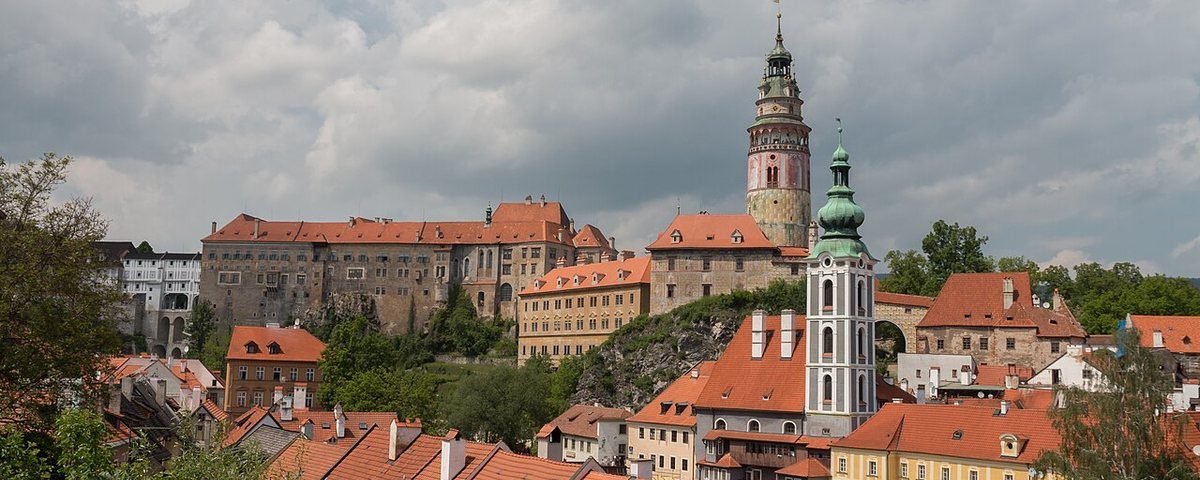
Český Krumlov Castle sits on a rocky bluff above a tight loop of the Vltava river in South Bohemia, Czech Republic, looking down on a medieval town that is protected as a UNESCO World Heritage Site. It is one of the largest castle complexes in the country, with a painted round tower that is visible from almost anywhere in the old town. It is also the home of one of Central Europe’s best-known ghost stories, that of the White Lady. This guide covers the castle’s history, the legends told about it, what is known about the real woman behind the tale, and how to plan a visit.
A short history of Český Krumlov Castle
According to the castle’s official history, the original Gothic castle was founded by the Lords of Krumlov some time before 1250. They were a branch of the powerful Witigonen family, whose coat of arms carried a five-petalled rose. Wikipedia gives 1253 as the earliest documented reference, naming Witiko of Prčice. When the Lords of Krumlov died out in 1302, their relatives the Rosenbergs inherited the castle and kept their seat there until 1602. Under them, in the second half of the 16th century, the castle became a grand Renaissance residence. In 1602 Emperor Rudolf II bought the dominion, and Emperor Ferdinand II later gave it to Johann Ulrich von Eggenberg, whose family held it until the male line died out. The official history dates that to 1719, while Wikipedia says 1717, and the Schwarzenbergs then inherited it.
Johann Christian I von Eggenberg turned the castle into a Baroque seat, and later the Schwarzenbergs made major alterations of their own. Wikipedia notes that the Castle Theatre, dating from the 1760s, is one of the best preserved Baroque theatres in the world. The Schwarzenberg property, including Český Krumlov, was transferred to provincial ownership in 1947, and in 1950 it became the property of the Czechoslovak state. The castle is now managed by the National Heritage Institute of the Czech Republic. UNESCO inscribed the historic centre of Český Krumlov, which includes the castle, on the World Heritage List in 1992.
The White Lady of Český Krumlov
The best-known tale is the White Lady, a ghost said to walk through the Rosenberg castles of South Bohemia, with Český Krumlov among the places most strongly tied to her. Unlike most castle ghosts, she is linked to a woman who left a documented life.
Perchta of Rosenberg
The castle’s own encyclopedia of Český Krumlov describes Perchta of Rosenberg, born around 1429, as the daughter of Ulrich II of Rosenberg. In 1449 she was married to Jan of Lichtenstein against her will. According to the encyclopedia, her private letters show that her husband mistreated her both mentally and physically. The castle’s retelling adds that she appealed in vain to her brother for rescue, since the morals of the time did not allow a wife to leave her husband. After his death she returned to her family’s castle, where she is remembered as a kind patron of the poor, and she died in 1476 at the age of 49. Because her letters survive, she is one of the better-documented noblewomen of her time in Bohemia, and the sadness in them is probably why the legend attached itself to her.
How a woman became a ghost
The encyclopedia says that the writer Bohuslav Balbín identified Perchta with the famous White Lady of the Rosenbergs, who was reported at Krumlov, Rožmberk, Telč and Jindřichův Hradec. In the tales she is a slender figure in a simple white dress with keys at her waist, walking the corridors and chambers of the castles before important events. A smile is a sign of good news, while black gloves and a solemn face foretell disaster or death. The castle’s separate list of legends puts the glove omen the other way round, with white gloves for good tidings and black for trouble.
Several stories explain why she walks. In one, her dying husband asked her forgiveness, she refused, and he cursed her, so that her soul has to roam the Rosenberg castles. In another, the White Lady is a protector of the family’s children. The castle’s retelling describes how she comforted the infant Petr Vok when his nurses fell asleep. A new nurse who did not know her challenged her, and the lady said the child belonged to her family, asked the wet nurse to tell him one day how much she had loved him, and then vanished into a wall as a small white cloud. When Petr Vok grew up, he is said to have had the wall demolished and to have found treasure there. These are folk tales. What is documented is a real, unhappy woman, a recorded 15th-century marriage, and centuries of retelling.
Other tales from the castle
The White Lady is not alone. The castle’s official collection of tales includes several shorter stories. Two guards of the salt house are said to have killed each other over a game of dice, and their fighting is still heard. A coppersmith who drowned in the castle pond while fetching reeds is said to knock at the brewery on nights of the full moon. A helpful Rosenberg butler is said to look after the wine in the cellars long after his death. An unknown lady in a red Rococo dress is said to appear at parties in the Bellaria summer house, and a young actress is said to have left a bloodstain on the stage of the castle theatre. These are presented by the castle as local folklore, and none has independent documentary support.
Visiting Český Krumlov Castle
The castle complex is a large site with five courtyards, a Baroque theatre, a garden, a museum and a tower, and different parts have different opening times. The official site is run by the National Heritage Institute, at zamek-ceskykrumlov.cz. Search results sometimes show look-alike or outdated sites for the castle, so it is best to book and check hours there.
Opening times are seasonal. As of October 25, 2026, the official site listed these times:
- The Castle Museum and Tower were open daily from 9:00 to 16:30 until 31 October, then Tuesday to Sunday from 9:00 to 15:30 from 1 November to 20 December.
- The castle garden was open daily from 7:00 to 17:00 in October.
- Guided interior tours and the Baroque Theatre tours were running on a Tuesday to Sunday schedule until 31 October, and the official page should be checked for the winter season.
Because the guided tours are seasonal, and the Baroque Theatre has limited visiting times, a winter visit may mean fewer interiors are open than in summer. The official site lists the current choices and online tickets.
Practical tips
- Book ahead in busy periods: Tours run at set times, so use the official ticket page to plan your visit.
- Allow time: The castle, tower and gardens can fill half a day, and the old town beneath is worth another few hours.
- Dress for the weather: Much of the route is outdoors or in unheated rooms, and the courtyards and bridges are exposed.
- Check each attraction separately: The museum, tower, theatre, garden and tour routes have different hours.
FAQ
Who is the White Lady of Český Krumlov?
In tradition she is Perchta of Rosenberg, a 15th-century noblewoman whose letters describe an unhappy marriage. The ghost story is legend. The woman and her letters are real.
Is Český Krumlov Castle open all year?
Not in full. Some parts, such as the garden and the Castle Museum and Tower, have longer seasons than the guided interior tours. Check the official site for current times.
Is the town part of the UNESCO listing?
Yes. UNESCO lists the historic centre of Český Krumlov, with the castle as a central part of it, as World Heritage Site number 617.
More haunted castles: Another White Lady tale is told at Château de Puymartin in France. For a fortress with a long and violent history, see the Castle of Good Hope in Cape Town.
Sources
- National Heritage Institute: Český Krumlov Castle (official site): opening times and visitor information, checked October 25, 2026.
- Český Krumlov Castle: official tales and legends pages: the White Lady and other tales.
- Wikipedia: Český Krumlov Castle: history and dates.
- UNESCO World Heritage Centre: Historic Centre of Český Krumlov: listing details.
Shop the gear
Heads up: NicheStuff is our own shop, so we earn from purchases made through these links. Prices and availability are set on the store and can change.
Top image: Český Krumlov Castle in South Bohemia, Czech Republic. Photo: Marco Almbauer, Public domain, via Wikimedia Commons.