
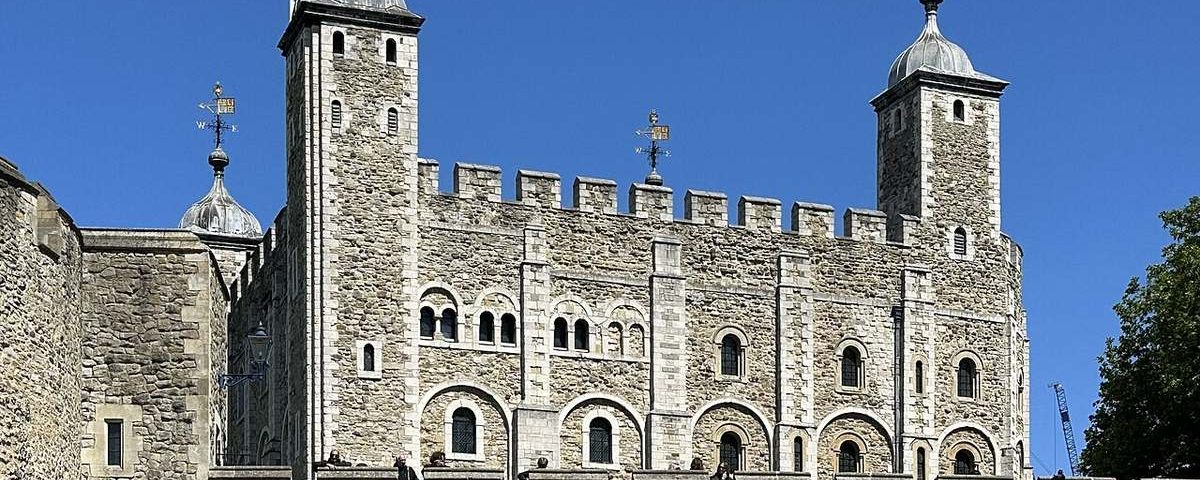
The Tower of London is a castle, and one of the best preserved in Europe. Its official name is His Majesty’s Royal Palace and Fortress of the Tower of London, and it stands on the north bank of the River Thames beside the City of London. It was founded in the months after the Norman Conquest of 1066, and its keep, the White Tower, gave the whole site its name. Over nine centuries it has served as a fortress, royal home, armoury, mint, menagerie and prison, and it is one of the best-known haunted places in Britain. This guide covers the documented history, the main ghost legends, what the record can and cannot support, and how to visit.
A short history of the Tower of London
After his victory at Hastings in October 1066, William the Conqueror spent the rest of the year securing his hold on England, and London was one of the keys. A fortification was begun in the south-east corner of the old Roman city wall, beside the river. Work on the stone White Tower is usually dated from about 1078, although the exact year is uncertain. UNESCO, which inscribed the Tower as a World Heritage Site in 1988, calls it the most complete survival of an 11th-century fortress palace in Europe.
The castle grew in stages. Richard I added an inner ward, and in the 13th century Henry III and Edward I extended the defences into the ring of towers, walls and moat that still shapes the site. The result is a concentric castle, with one line of defence set inside another, and the layout has barely changed since Edward I finished his rebuilding in 1285. Wikipedia counts 13 towers along the inner curtain wall, among them the Bloody Tower, the Beauchamp Tower and the Wakefield Tower. Until 1661 it was also traditional for a new monarch to prepare for coronation at the Tower and process from there to Westminster Abbey.
As Historic Royal Palaces points out, the Tower was not built as a prison, but it became the country’s best-known state prison. Most inmates were high-ranking people held for limited periods. The first recorded prisoner, Bishop Ranulf Flambard, was also the first to escape, in 1101. The 16th and 17th centuries were the peak of its use. Its grim reputation owes much to Tudor religious writers and Victorian authors, and Wikipedia notes it never had a permanent torture chamber. Only seven people were executed inside the walls before the 20th century, most being put to death on Tower Hill outside.
The ghost legends of the Tower
Anne Boleyn
Anne Boleyn, the second wife of Henry VIII, is the Tower’s best-known ghost. The history is documented. She was arrested on 2 May 1536 on charges of adultery and plotting against the king, found guilty, and beheaded on Tower Green on 19 May 1536. She was buried in the Chapel of St Peter ad Vincula, within the Tower.
The ghost story is a later tradition. Historic Royal Palaces retells the legend that her spirit leads a silent procession from Tower Green to the chapel, and Wikipedia says other tellings have her walking near the White Tower with her head under her arm, the subject of a 1934 comic song. A much-repeated tale from 1864 describes a rifleman who challenged a white figure near the King’s House and was found collapsed. Historic Royal Palaces says he was court-martialled, then acquitted when two witnesses backed his account. The independent site Anomaly Watch says no 1864 record of the case has been found, so it should be read as a story rather than an event.
The Princes in the Tower
In 1483 the 12-year-old Edward V and his younger brother Richard, Duke of York, were lodged in the Tower after the death of their father, Edward IV. Their uncle, the Duke of Gloucester, was their Lord Protector and was crowned Richard III that July. Historic Royal Palaces says the boys were last reported playing in the Tower garden in June and were then seen less and less. It is now widely believed they were killed that autumn, but no one can say by whom, and suspicion of Richard III rests largely on accounts written decades later.
Workmen found two child-sized skeletons near the White Tower in 1674. Charles II had them reburied in Westminster Abbey, and a re-examination in 1933 concluded they were of two boys aged about 10 and 12. They have never been proved to be the princes. Wikipedia lists the princes among the Tower’s reported ghosts, but that legend rests on an unsolved disappearance.
The Bloody Tower
The Bloody Tower began as a water gate in the 13th century. Wikipedia says it gained its present name in the 16th century because people believed the princes were murdered there, and it was earlier known as the Garden Tower. It is better documented as the lodging of Sir Walter Raleigh, who was held there with his family in relative comfort. The Victorian magazine All the Year Round reported a belief that his spirit glided about the place.
Margaret Pole, Countess of Salisbury
Margaret Pole was the daughter of the Duke of Clarence and was 67 when she was executed in the Tower on 27 May 1541. The imperial ambassador Eustace Chapuys wrote that the executioner was an inexperienced youth and that her death was badly handled. A 17th-century account has her refusing the block, which grew in the retelling into a story of a chase around the scaffold. The ghost legend says she relives her final moments on the anniversary. Her execution and burial in the chapel are recorded history, while the haunting is tradition only.
Lady Jane Grey and other reported tales
Lady Jane Grey, proclaimed queen in July 1553, was beheaded within the Tower walls on 12 February 1554, aged 17. Historic Royal Palaces says her ghost is said to walk the battlements on the anniversary, and that two guardsmen reported a white shape there in 1957. The same article lists Henry VI said to appear in the Wakefield Tower each 21 May, a “shapeless white form” seen on the Salt Tower in 1957, and a Victorian “phantom bear” story, which it links to the Victorian interest in spiritualism.
The ravens
Visitors are told that if the ravens ever leave, the kingdom will fall. Historic Royal Palaces presents this as a legend, saying that by tradition Charles II ordered at least six ravens to be kept after his astronomer, John Flamsteed, complained that they hampered work in the White Tower. The record is thin. One researcher of raven folklore found no references to captive ravens at the Tower before the late 19th century, the earliest known pictures date from 1883, and the Tower’s historian has called the mythology a probable Victorian invention. The birds are real, but the prophecy is folklore.
What the record can and cannot support
The imprisonments, trials and executions described here are documented, as are the dates for Anne Boleyn, Lady Jane Grey and Margaret Pole. The ghost stories are not. Most are told in sources from the 18th and 19th centuries or later, and none comes with firm evidence. They are best read as folklore shaped by the Tower’s violent past and by the Victorian taste for gothic tales.
Visiting the Tower of London
The Tower of London is at London EC3N 4AB, about five minutes on foot from Tower Hill Underground station. Tickets are booked through the official Historic Royal Palaces website, which also lists tickets, route closures and events. Opening hours change by season. In late November 2026 the Tower was open about 9am (10am on Mondays and Sundays) to 4:30pm, with last entry at 3pm. Check the official opening times page before you travel.
Practical tips
- Time: The official site suggests allowing at least two to three hours, depending on queues.
- Guided tours: Yeoman Warder tours are included in the ticket, and afternoons are quieter than mornings.
- Parking: There is no car park at the Tower, so public transport is the usual choice.
- Bags: There is no left luggage, and suitcases and large or rolling bags are not allowed inside.
- Ground: Surfaces are uneven, worn and sometimes slippery, so wear sturdy footwear.
- The chapel: The Chapel Royal of St Peter ad Vincula is a working chapel and may be closed on some days.
- Ravens: Visitors are asked not to feed the ravens, which can bite.
FAQ
Is the Tower of London a castle?
Yes. It is a Norman castle begun after 1066, with the White Tower as its keep and concentric rings of walls and a moat built around it.
Is the Tower of London haunted?
It has a famous reputation for it, but every ghost story is legend. The imprisonments and executions are documented history, while reported sightings of Anne Boleyn, the princes and others are folklore.
Are the ravens really protecting the kingdom?
That is a legend. Researchers have found no sign of the tradition before the late 19th century, although ravens are kept at the Tower today.
More haunted castles: Other castles with ghost-story reputations include Culzean Castle in Ayrshire and Ballygally Castle in Northern Ireland. A fortress with its own prison history is covered in the post on the Castle of Good Hope, and a French castle with a lady in white is the subject of the post on Château de Puymartin.
Sources
- Tower of London: opening and closing times: opening hours, read October 25, 2026.
- Tower of London: visit: address, transport, bags, surfaces, no on-site parking.
- Historic Royal Palaces: The Tower as a prison: first prisoner, Anne Boleyn, Jane Grey, Raleigh, torture and reputation.
- Historic Royal Palaces: Anne Boleyn: arrest, execution on 19 May 1536 and burial.
- Historic Royal Palaces: The Princes in the Tower: 1483, the 1674 skeletons and the 1933 examination.
- Historic Royal Palaces: Famous ghost stories of the Tower of London: Anne Boleyn, 1864 rifleman, Jane Grey, Henry VI, the bear.
- Historic Royal Palaces: Margaret Pole: execution on 27 May 1541 and burial in the chapel.
- Historic Royal Palaces: The Ravens: raven legend, Charles II tradition and visitor warning.
- All the Year Round, volume XIV, page 276: Victorian report of the Raleigh and Bloody Tower tales.
- UNESCO World Heritage Centre: Tower of London: 1988 inscription and Outstanding Universal Value.
- Wikipedia: Tower of London: layout, towers, executions, reputation, folklore section.
- Wikipedia: Ravens of the Tower of London: Parnell and Sax findings, 1883 depictions.
- Boria Sax: How Ravens Came to the Tower of London: abstract of the research on the raven tradition.
- The Tudor Society: Margaret Pole: Chapuys account and later embellishment.
- Anomaly Watch: the 1864 sentry story: no 1864 record found.
Shop the gear
Heads up: NicheStuff is our own shop, so we earn from purchases made through these links. Prices and availability are set on the store and can change.
Top image: The White Tower at the Tower of London, London. Photo: APK, CC BY 4.0, via Wikimedia Commons.